top of page


MAKING SENSE OF AUTISM®
Blog
All Posts

Why Self-Awareness Changes Everything for Autistic Individuals
One of the biggest things autistic individuals need from you, from me, from parents, from therapists isn’t more correction or teaching. It’s someone truly noticing them. This week on Making Sense of Autism, Susan Golubock and I had one of the most emotional conversations we’ve had in a long time about self-awareness, people pleasing, connection, and what actually helps autistic individuals want to communicate and connect. Hearing Sue describe these experiences in her own word
Staci Neustadt
8 hours ago5 min read


We Got This Wrong: Rethinking Autistic Social Communication
Autistic social communication is often misunderstood in classrooms, therapy, and everyday life. In this video and blog, speech-language pathologist Staci Neustadt and autistic occupational therapist Susan Golubock explain why eye contact, social skills, and pragmatic language are frequently misinterpreted in autism support. Learn neurodiversity-affirming strategies for parents, teachers, SLPs, and therapists to better understand autistic communication and support autistic ind
Staci Neustadt
May 63 min read


From 'You'll Never Succeed' to Special Ed Teacher: What One Autistic Educator Wants Every Teacher to Know
When an autistic student is dysregulated, most educators respond to the behavior. But according to autistic teacher and advocate Becca Engel, that's exactly where we get it wrong.In this episode of Making Sense of Autism, Becca joins SLP Stacy Nustat and occupational therapist Susan Galabach to unpack what's really happening in a child's nervous system during moments of dysregulation — and why the traditional compliance-based approach to classroom behavior may be doing more h
Staci Neustadt
Apr 291 min read

Do Autistic Individuals Really Struggle with Perspective Taking?
What if autistic individuals don’t lack perspective taking… but experience and express it differently? This blog challenges a long-held belief and offers a more meaningful way to support connection.
Staci Neustadt
Apr 242 min read
I keep trying to engage them — but nothing is working
You've tried everything. You brought in their favorite topic. You changed the activity. You adjusted your approach, your tone, your timing. You've read the books, attended the trainings, and genuinely care about getting this right. And still — they seem somewhere else entirely. Disengaged. Unreachable. Like nothing you do is landing. Before you question your skills, your patience, or your instincts — consider this: the problem may not be engagement at all. It may be the frame
Staci Neustadt
Apr 173 min read

It's not about the toys....autistic play
What If We’ve Been Misreading Autistic Play? You might have seen it…—or experienced it yourself. Doing the same thing over and over.Lining things up.Dropping, spinning, repeating. And somewhere along the way, many of us were taught: 👉 “That’s not functional.” 👉 “We need to redirect that.” 👉 “That’s not how play is supposed to look.” But what if that’s not the full picture? What Looks Repetitive Might Be Meaningful From an autistic perspective, play often has a purpose that
Staci Neustadt
Apr 91 min read
Autism Awareness vs Acceptance: A Simple Shift That Changes Everything
Autism awareness vs acceptance explained. Learn how behavior is communication and how to better support autistic individuals.
Staci Neustadt
Apr 21 min read
Do Visual Schedules Work for Autistic Kids? (Or Are We Using Them Wrong?)
Learn why power struggles happen with autistic children and how to reduce meltdowns, build trust, and increase engagement using supportive strategies.
Staci Neustadt
Mar 261 min read


Tired of Power Struggles?
Struggling with power struggles and a strong-willed child? Learn how to reduce resistance, build connection, and support cooperation using relationship-based strategies.
Staci Neustadt
Mar 193 min read

Does Neuroaffirming Support Mean Accepting Every Behavior?
Does neuroaffirming support mean accepting every behavior? Learn why understanding autistic behavior is not the same as excusing it.
Staci Neustadt
Mar 121 min read

Autism, Trauma, and Behavior in Schools: Why an Empathy Approach Matters
When a student lashes out, shuts down, or refuses to participate, the response in many schools is immediate: stop the behavior. But what if the behavior is not the real problem? Research shows that 60–65% of students report at least one Adverse Childhood Experience (ACE) . Even more concerning, studies estimate that 70–90% of autistic individuals report experiencing at least one traumatic event in their lifetime. For many autistic students, behavior is not defiance. It is a s
Staci Neustadt
Mar 52 min read
When the Scores Don’t Tell the Whole Story
You’re Seeing the Whole Child… Now What? Last week, we talked about why autism assessments must look at the whole child — not just test scores, deficits, or isolated skill areas. If you haven’t read that yet, start there. Because this week builds on it. Seeing the whole child is the first step. But then comes the deeper question: Are we building on the right foundation? You can write holistic reports. You can identify strengths and stressors. You can move beyond comparison t
Staci Neustadt
Feb 192 min read
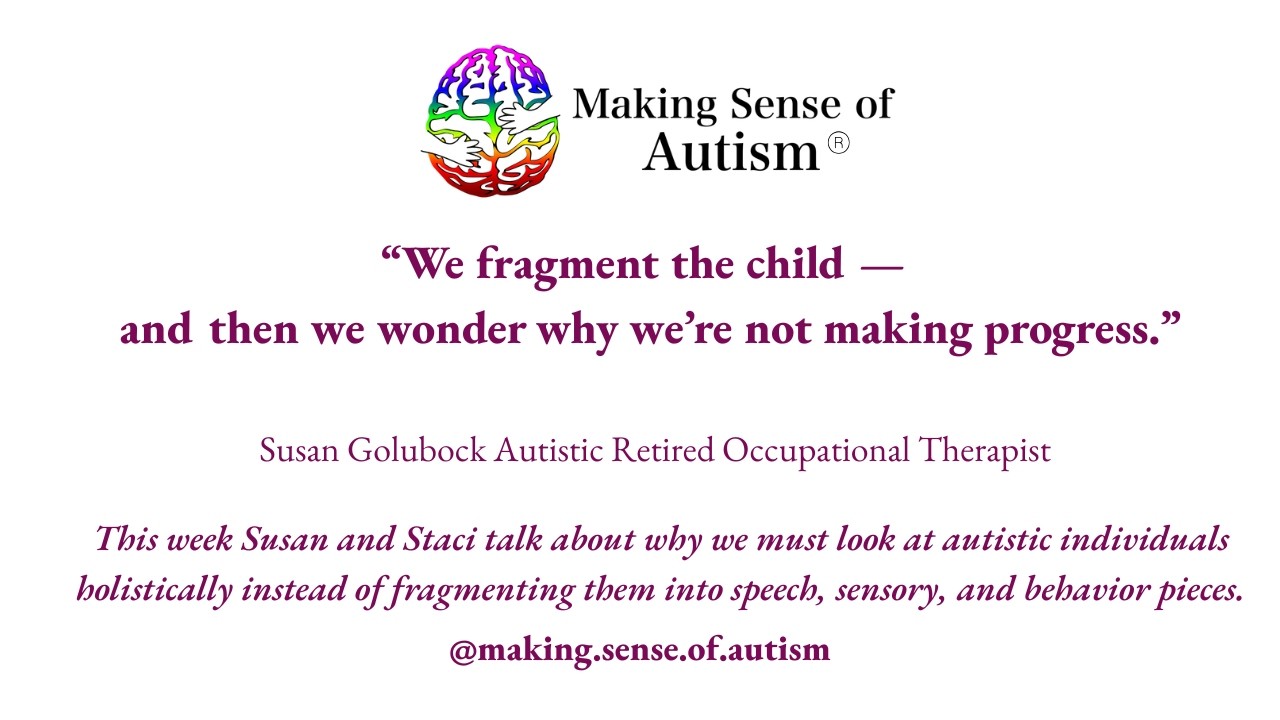
What Standardized Assessments Don’t Tell Us About Autistic Students/Clients
Standardized assessments help determine services — but they were never designed around autistic neurology. In this week’s video, we explore what those scores don’t tell us and why looking at the whole child changes everything.
Staci Neustadt
Feb 121 min read

Behavior as a Safety Signal
This blog helps you discover if the behavior is due not feeling safe
Staci Neustadt
Jan 292 min read

You’re Not Failing. The Strategies Just Aren’t Working.
If the strategies you’re using with an autistic child aren’t working, you’re not failing. You may be missing key information about how the autistic brain processes pressure, motivation, and learning. This conversation explains what’s missing—and what to do instead.
Staci Neustadt
Jan 221 min read


They’re Not Refusing — They’re Not Ready
Understanding why your child says "no"
Staci Neustadt
Jan 152 min read


Building on Autistic Strengths: Why Hope Starts With What They Want to Achieve
Many parents and professionals look at an autistic child and think: They’re so smart. They’re capable. They should be able to do more by now. And when progress doesn’t happen, the blame quietly turns inward. This conversation isn’t about doing more. It’s about looking differently . This week at Making Sense of Autism , we talk about hope —not as positivity or optimism, but as a grounded, realistic belief that there is a better way to understand autistic behavior, motivation,
Staci Neustadt
Jan 102 min read

The One Sentence That Changes Everything About Understanding Autism
Have you ever misread an autistic individual’s behavior? Most of us have. Not because we’re uncaring — but because we’ve been taught to look at behavior first instead of the differences underneath it. And then Susan said a sentence that changed everything for me: “Look for the differences — not how we’re alike.” It’s simple, but it completely shifts how we understand autistic communication, behavior, and connection. We Celebrate Acceptance on Screen… But Struggle With It in
Staci Neustadt
Nov 28, 20252 min read

Invitation, Not Expectation: How Understanding Autistic Communication Changes Everything
Have you ever tried to teach a skill—getting dressed, cleaning up, leaving the house, or even answering a simple question—and your autistic child or student shuts down, resists, or becomes overwhelmed? Most people assume it’s behavior. But what if it’s really expectation? In this week’s vlog, autistic retired Occupational Therapist Susan Golubock and Speech-Language Pathologist Staci Neustadt talk about something most people never realize: even small, invisible expectations
Staci Neustadt
Nov 20, 20252 min read

When a “Good” Child Suddenly Isn’t: What Autistic Autonomy Really Looks Like
What if I told you that a “good,” compliant, easy” autistic child is not a sign of things going well…but a red flag ? I know—that sentence alone stops people in their tracks. But stay with me. I have heard several times in my two decades as an SLP: “They’ve always been such a good kid. So easy. So compliant. But now everything is suddenly a battle.” They describe a child who once went along with everything…who now refuses, melts down, pushes back, or flat-out says “no.” And
Staci Neustadt
Nov 13, 20252 min read
bottom of page